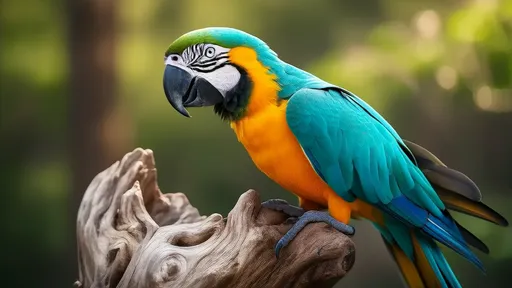
In the dense rainforests of Australia, a sudden burst of human laughter echoes through the canopy, followed by a perfect imitation of a chainsaw's roar. This auditory illusion is not the work of a prankster forester but the vocal mastery of a wild parrot, one of nature's most astonishing acoustic mimics. For centuries, the ability of parrots to replicate human speech, environmental sounds, and even musical melodies has captivated scientists and pet owners alike, positioning these birds as the undisputed vocal geniuses of the avian world.
The foundation of a parrot's mimicry lies in its unique vocal anatomy. Unlike humans, who produce sound using the larynx, parrots utilize the syrinx, a complex organ located at the base of the trachea where it splits into the bronchi. This biological instrument is extraordinarily sophisticated, equipped with multiple pairs of muscles that allow for independent control of sound production on each side. This dual-voice box enables parrots to generate two distinct sounds simultaneously, creating the complex harmonies and layered noises that often characterize their mimicry. Furthermore, their thick, muscular tongues and specialized beaks act as precise modulators, shaping airflow and sound waves with remarkable dexterity to reproduce the subtle nuances of human vowels and consonants.
However, a sophisticated instrument is useless without a skilled musician to play it. The parrot's brain is the true conductor of this symphony of sound. Research has pinpointed key areas, often referred to as "song systems," within the avian brain that are responsible for vocal learning and production. In parrots, these neural circuits are exceptionally large and complex. A 2015 neurological study revealed that parrots possess a unique "shell" structure surrounding the core song system, a feature not found in other vocal-learning birds like songbirds. This additional neural architecture is believed to be what grants parrots their superior ability to imitate a vast repertoire of sounds with such high fidelity, from the whisper of a rolling marble to the precise inflection of a question.
While the how is a marvel of biology, the why remains a subject of intense scientific debate. In their natural habitats, mimicry is far more than a party trick; it is deeply woven into their social fabric. Wild parrots are highly social, living in large, dynamic flocks where individual recognition is crucial. Scientists hypothesize that the ability to mimic the unique contact calls of flock mates strengthens social bonds and reinforces group cohesion. A parrot may adopt elements of another's call, effectively creating a shared vocal signature that says, "we belong together." This vocal flexibility also plays a role in mating, where a diverse and complex vocal performance can signal intelligence and fitness to a potential partner.
Beyond social bonding, mimicry serves as a powerful tool for survival. Some species have been observed mimicking the calls of predatory hawks or eagles. The sudden, unexpected cry of a raptor can create instant panic, scattering smaller birds and allowing the parrot to swoop in and claim an uncontested feeding ground without a physical fight. This form of acoustic deception demonstrates a startling level of cognitive processing, where the parrot must not only learn the sound but also understand its context and emotional impact on other animals to deploy it effectively for its own benefit.
The journey from hearing a sound to reproducing it is a complex cognitive feat. It begins with exceptional auditory perception; parrots can discern fine acoustic details that many other animals would miss. This sound is then processed and stored in memory. The learning process is not instantaneous; it involves a period of practice and auditory feedback, much like a human child learning to speak. A young parrot will babble and experiment with sounds, gradually refining its vocalizations until they match the memorized template. This trial-and-error process highlights a degree of conscious control and learning plasticity that is rare in the animal kingdom.
The most famous example of parrot intelligence and mimicry is the work done with Alex, an African Grey parrot studied by animal psychologist Irene Pepperberg. Alex did not merely mimic; he demonstrated an ability to associate sounds with meanings. He could correctly identify objects, their colors, shapes, and quantities, and even express desires like wanting to go back to his cage. His use of language was purposeful and communicative, suggesting that for some parrots, mimicry can be a gateway to a form of symbolic communication, blurring the line between simple imitation and genuine comprehension.
This incredible ability to connect with humans on an auditory level is precisely why parrots have been cherished companions for millennia. From ancient Roman nobles to modern households, people have been fascinated by a creature that can seemingly bridge the communicative gap between species. A parrot that greets its owner or asks for a snack creates a profound and unique bond. However, this very talent contributes to their conservation crisis. The pet trade, fueled by the desire to own these talking marvels, is a significant driver behind the endangerment of many parrot species, highlighting a tragic irony where their greatest asset becomes their greatest vulnerability.
Despite our fascination, the life of a talking parrot in a human home is often fraught with misunderstanding. These are intelligent, social, and long-lived wild animals whose complex needs are rarely met in captivity. Behavioral issues like excessive screaming or feather plucking are common manifestations of psychological distress, often stemming from boredom, loneliness, or inadequate stimulation. The novelty of a mimicking bird can quickly wear thin if owners are not prepared for the immense responsibility of caring for a creature whose cognitive and emotional needs rival those of a young child.
The phenomenon of parrot vocal mimicry stands as a stunning testament to evolutionary innovation. It is a perfect storm of specialized physical equipment, advanced neural hardware, and complex social drivers. They challenge our very definitions of communication and intelligence in the animal kingdom. As we continue to study these feathered linguists, from the raucous macaws in the rainforest to the thoughtful Greys in research labs, we are continually reminded that the most intelligent conversations on our planet are not always our own. Their voices echo a profound truth about the interconnectedness of life and the many astonishing forms that intelligence can take.
By /Aug 21, 2025
By /Aug 21, 2025

By /Aug 21, 2025

By /Aug 21, 2025
By /Aug 21, 2025
By /Aug 21, 2025
By /Aug 21, 2025

By /Aug 21, 2025
By /Aug 21, 2025

By /Aug 21, 2025
By /Aug 21, 2025
By /Aug 21, 2025
By /Aug 21, 2025
By /Aug 21, 2025
By /Aug 21, 2025

By /Aug 21, 2025
By /Aug 21, 2025
By /Aug 21, 2025

By /Aug 21, 2025

By /Aug 21, 2025
